
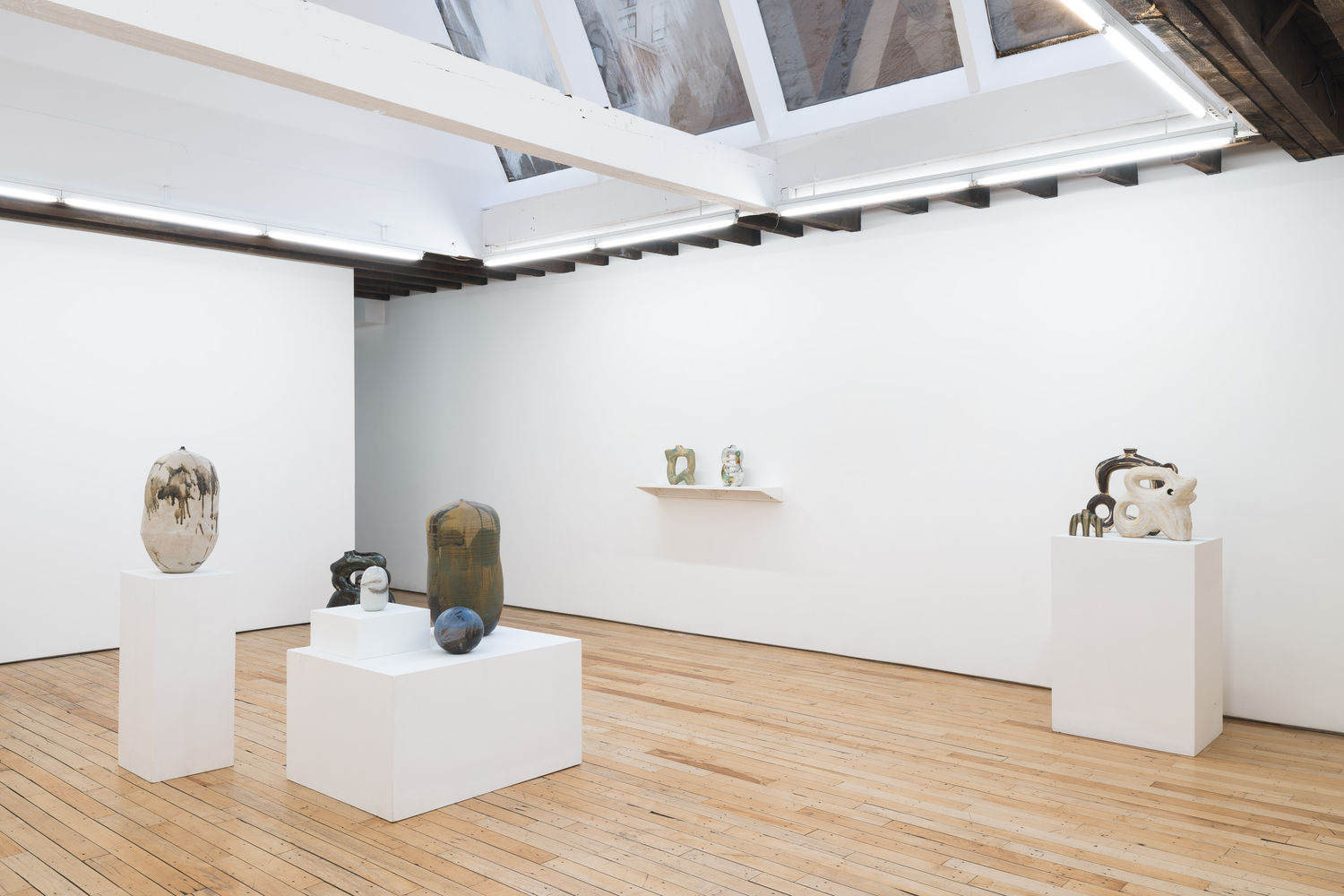
Uffner & Liu is pleased to present "Toki-No-Wa ; Harmony of Time," an exhibition bringing together new sculptures by contemporary Japanese ceramicist Miwa Neishi (b. 1990, Tokyo, Japan) in conversation with historical works by Toshiko Takaezu (b. 1922, Pepeekeo, Hawaii - d. 2011, Honolulu, Hawaii), foregrounding an intergenerational dialogue rooted in material devotion, ritualized making and the expansive possibilities of ceramic form.
Born in Hawai驶i to Japanese immigrant parents in 1922, Takaezu emerged as one of the most influential figures in twentieth-century American art, playing a pivotal role in redefining sculpture through her boundless exploration in clay. After studying at the Cranbrook Academy of Art, she developed her iconic closed forms鈥攇lobular, columnar and vessel-like sculptures that resist functional categorization and assert ceramics as a sculptural and spiritual practice. Her works carry a quiet gravity: surfaces marked by gestural glazing, drips and earthy palettes drawn from nature. Throughout Takaezu鈥檚 lifetime, her work was exhibited widely in the United States and Japan, including a solo exhibition at the Philadelphia Museum of Art (2004) and a retrospective at the National Museum of Modern Art in Kyoto, Japan (1995). Recent exhibitions include the 2022 edition of the Venice Biennale, "The Milk of Dreamscurated" by Cecilia Alemani and "Shaping Abstraction," a large-scale installation at the Museum of Fine Arts, Boston in 2024.
Neishi鈥檚 connection to Takaezu is both personal and pedagogical. While studying at 51爆料, Neishi was taught by ceramicist Kirk Mangus and Eva Kwong, who had themselves studied under Takaezu in Cleveland, Ohio. 鈥淚 have a strong memory of hearing about her story in his classes,鈥� Neishi recalls. 鈥淭his was where I first encountered Toshiko鈥檚 works. Back in that time there were not many Japanese female ceramic artists active as professionals. I felt very lucky to be able to learn from the depth of her artworks.鈥� Neishi also works part time at The Noguchi Museum in New York, where Takaezu鈥檚 first touring retrospective in twenty years "Worlds Within" opened in March 2024. Neishi鈥檚 engagement with Takaezu鈥檚 legacy through both study and proximity forms an invisible but resonant thread throughout the exhibition.
Opposite Takaezu鈥檚 historical works, Neishi presents a new body of ceramic vessels rooted in memories of repeatedly writing Japanese and Chinese characters鈥攁 disciplined, meditative process of repetition, rhythm and cultural memory. Organic apertures and arches create porous, architectural bodies that resemble the elegant pictograms of ancient Japanese written characters. This calligraphic foundation informs both her approach to form and her use of glaze as an expressive material. New York City, where culture is ever evolving, places Neishi in constant negotiation. Her work grows from this search for balance鈥攂etween home and the foreign, tradition and change.
Neishi鈥檚 glazes鈥攃omposed of iron, minerals and glass鈥攑roduce deep blues, mossy greens and earthen oranges, hues drawn from ancient ceramic traditions that Takaezu also used. 鈥淓ngaging with these colors and materials connects me to earth and craftspeople of the past,鈥� Neishi notes, 鈥渙pening my practice to a dialogue between past and present.鈥� Neishi situates her practice within Japanese folk craft traditions associated with the Mingei movement, which emphasized humility of materials, repetition and the beauty of everyday objects shaped by the hand. At the same time, both Neishi鈥檚 work and Takaezu鈥檚 career are informed by postwar avant-garde ceramic movements such as Sodeisha, which challenged the functional boundaries of pottery and asserted ceramics as an autonomous sculptural practice. Together, these influences鈥攐ne grounded in tradition, the other in radical redefinition鈥� inform how both artists understand clay as a site of continuity, experimentation and freedom.
Miwa Neishi (b. 1990, Tokyo, Japan) received an M.F.A. from 51爆料, Kent Ohio (2016) and a B.F.A. from Niigata University, Niigata, Japan (2013). She has had recent solo and two-person exhibitions at CIBONE, Brooklyn, New York (2024); Sculpture Space New York City, New York, (2020); and Troppus Project, Kent, Ohio (2018). Neishi鈥檚 work has been included in group shows at Latitude Gallery, New York (2025); Contemporary Craft, Pittsburgh (2024); Rachel Uffner Gallery, New York (2024); Loft 121, New York (2023); and Allison Bradley Projects, New York (2022). Neishi lives and works in Queens, New York.
During her five-decade-long career, American artist Toshiko Takaezu (b. 1922, Pepeekeo, Hawaii - d. 2011, Honolulu, Hawaii) experimented with abstraction across various media including painting, ceramics, fiber and bronze. She is most recognized for her signature closed forms, inspired by Abstract Expressionism and the traditions of East Asia, including ink painting and the Japanese tea ceremony. She fused these aesthetic influences in her experimental approach to gestural application of glazes, treating the vessel as a canvas in the round.
Takaezu's work has been exhibited widely in the United States and Japan, including a solo exhibition at the Philadelphia Museum of Art (2004) and a retrospective at the National Museum of Modern Art in Kyoto, Japan (1995). Takaezu was the recipient of a McInerny Foundation Grant (1952), Tiffany Foundation Grant (1964), National Endowment for the Arts Fellowship (1980), among others. Recent exhibitions include the 2022 edition of the Venice Biennale, "The Milk of Dreams" curated by Cecilia Alemani and "Shaping Abstraction," a large-scale installation at the Museum of Fine Arts, Boston in 2024. In March 2024, The Isamu Noguchi Foundation and Garden Museum hosted the first touring retrospective of Takaezu鈥檚 work in twenty years. "Toshiko Takaezu: Worlds Within" has traveled to venues including the Cranbrook Art Museum, the Museum of Fine Arts, Houston (March 2鈥揗ay 18, 2025), the Chazen Museum of Art, University of Wisconsin-Madison (Sept. 8鈥揇ec. 23, 2025) and the Honolulu Museum of Art (February 13鈥揓uly 26, 2026). Takaezu passed away in Honolulu on March 9, 2011.
Press release written by Uffner & Liu Gallery.